

Get quote
Get Free Consultation!
We are ready to answer right now! free consultation.
Email:ttxxkj888@gmail.com
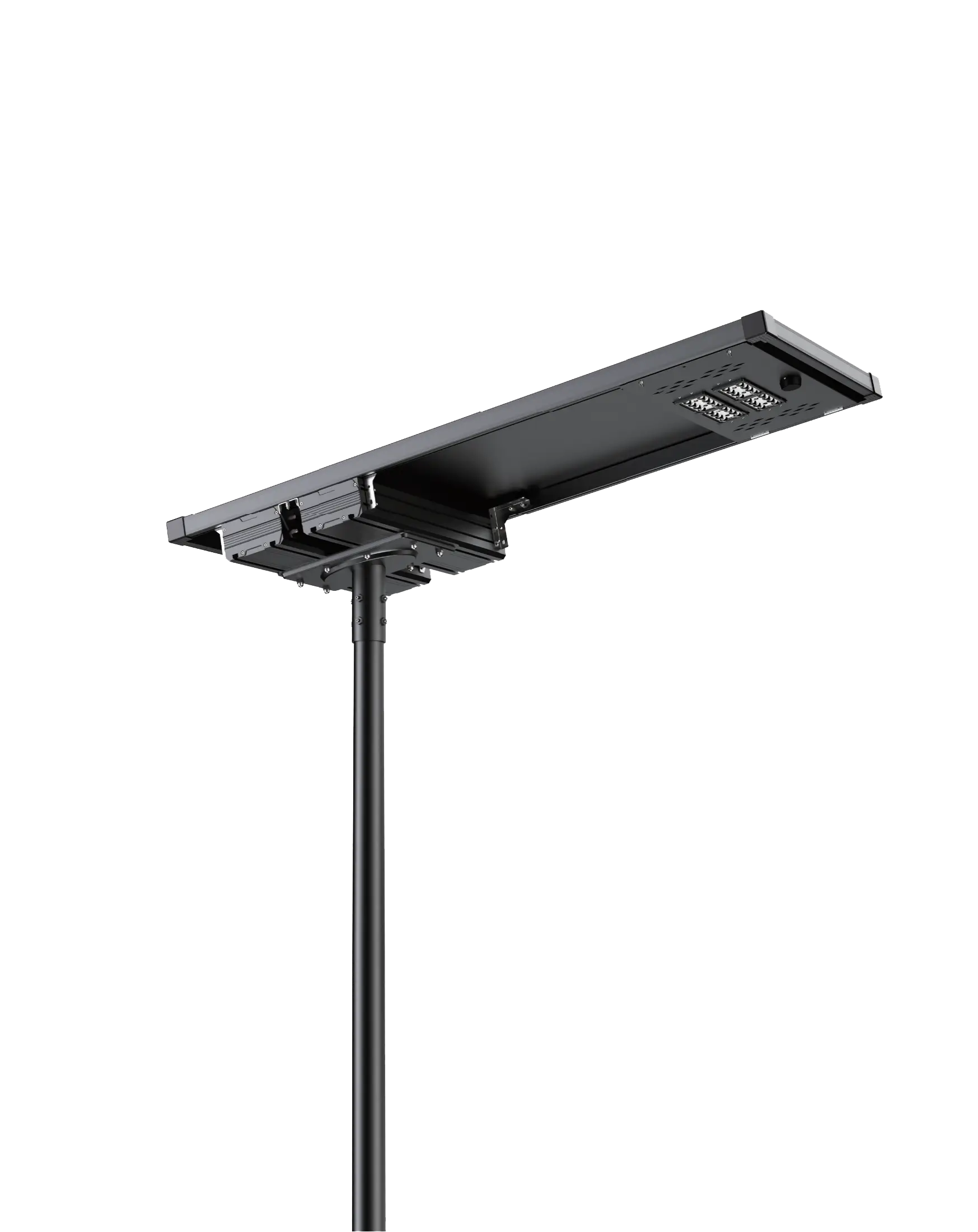
Solar street light pole spacing is not a product-only decision. A buyer has to connect the road width, mounting height, light distribution, fixture power, battery route, and maintenance access before approving a bill of quantities. For AilumPower projects, the starting products are the AP-ISLH-CV Integrated Solar Lamp Head for 6m to 12m road routes, the AP-ISLH-CL Integrated Solar Lamp Head for pathways and small outdoor areas, and the AP-MSCILH-PS Mains-Solar Hybrid Lamp Head when the road needs solar contribution with grid support.
The first item to confirm is the actual zone. A campus path, a factory branch road, a park walkway, and an entrance road cannot be spaced from one single rule. Engineering references normally treat pole spacing as a calculation that depends on the luminaire, mounting height, optics, and road geometry. A practical buyer should use rules of thumb only to start the discussion, then approve the final layout with the selected AilumPower product route and the project drawing.
A road buyer often asks for solar street light pole spacing because the project drawing needs a quantity. That is understandable, but spacing cannot be solved by choosing the highest wattage lamp head first. Public roadway lighting guidelines treat mounting height, light distribution, spacing ratio, road geometry, and uniformity as linked design choices rather than isolated catalog values. Global street-design guidance also treats pole height and spacing together, with shorter poles needing closer intervals and wider streets often needing taller poles.
That general engineering logic matters for AilumPower products because the same project may include several lighting zones. AP-ISLH-CL01 and AP-ISLH-CL02 are 10W and 15W integrated solar lamp heads with 3.2V/36Ah and 3.2V/72Ah lithium batteries. They belong in pathways, small park edges, and lower-risk outdoor areas. AP-ISLH-CV01, CV02, and CV03 move into 60W, 80W, and 120W product routes with recommended mounting heights of 6m/8m, 8m/10m, and 10m/12m. Those products should not be spaced as if they were decorative path lights.
For a campus walkway or park path, the buyer may care more about pedestrian comfort, lower glare, and easy maintenance than about long pole spacing. AP-ISLH-CL uses batwing light distribution of 150 degrees by 75 degrees and lower power choices. A project team might use it where poles are closer, where the lighting task is modest, and where the appearance of small fixtures matters. If the project later adds vehicle traffic or wider road sections, the buyer should move the discussion toward AP-ISLH-CV or AP-MSCILH-PS instead of stretching the CL route beyond its role.
For a factory entrance road, pole spacing becomes a safety and visibility decision. AP-ISLH-CV03 is a 120W integrated solar lamp head using DC24V, a 25.6V/108Ah lithium battery, and a 275W/36V monocrystalline solar panel, with recommended mounting height of 10m/12m. That is a different starting point from AP-ISLH-CV01 at 60W, DC12V, a 12.8V/96Ah lithium battery, and a 140W/12V panel. The buyer should not issue a single spacing number until the CV model and the road width are both clear.
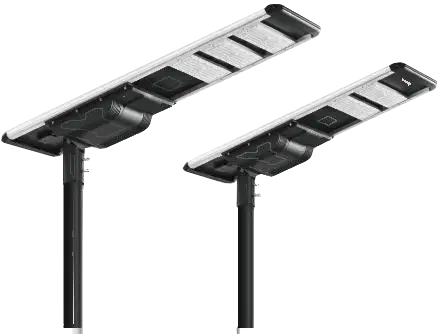
AilumPower’s AP-ISLH-CV product page gives buyers several spacing-related facts before any calculation begins. The series uses batwing light distribution of 150 degrees by 75 degrees, CRI of at least Ra70, IP65 protection, IK08 impact rating, and LED lifespan over 50000 hours. The models differ by rated power, system voltage, battery size, panel size, product weight, mounting pipe diameter, and recommended mounting height. A buyer who keeps only “60W, 80W, 120W” in the purchase file loses too much information.
AP-MSCILH-PS adds another route. It covers 60-70W, 80-90W, 100-110W, 120-130W, and 140-150W power groups, with LiFePO4 battery groups, SRNE MPPT controller routes, 18V monocrystalline solar panels from 60W/70W to 140W/150W, 6-12h adjustable lighting time, IP65 protection, and 6-10m mounting height. This product makes sense when the road cannot rely only on solar storage and the buyer wants mains support as part of the operating plan.
| Project zone | AilumPower product route | Spacing decision should start from | When not to use it |
|---|---|---|---|
| Pathway, small park edge, courtyard | AP-ISLH-CL01 / AP-ISLH-CL02 | Lower mounting, pedestrian use, 10W or 15W power route, 3.2V battery group | Not for wide road sections that need higher mounting height and stronger light output |
| Campus road, branch road, park road | AP-ISLH-CV01 / CV02 | 6m/8m or 8m/10m mounting route, 60W or 80W output, battery and panel match | Not for main road areas where 120W or hybrid support is needed |
| Wider road or higher pole route | AP-ISLH-CV03 | 10m/12m mounting route, 120W output, 25.6V/108Ah battery, 275W/36V panel | Not for narrow walkways where glare, appearance, and cost matter more |
| Road needing grid support | AP-MSCILH-PS | 6-10m mounting route, 6-12h adjustable lighting time, MPPT controller, mains-solar operation | Not for simple solar-only paths or decorative public-space poles |
A mixed project is where many mistakes happen. A municipal road may include an entrance road, a branch road, parking access, pedestrian paths, and a public plaza. If the buyer asks for one spacing number, one wattage, and one pole type, the final order may be easy to quote but hard to install correctly. The safer method is to divide the project into zones first and then select the AilumPower route for each zone.
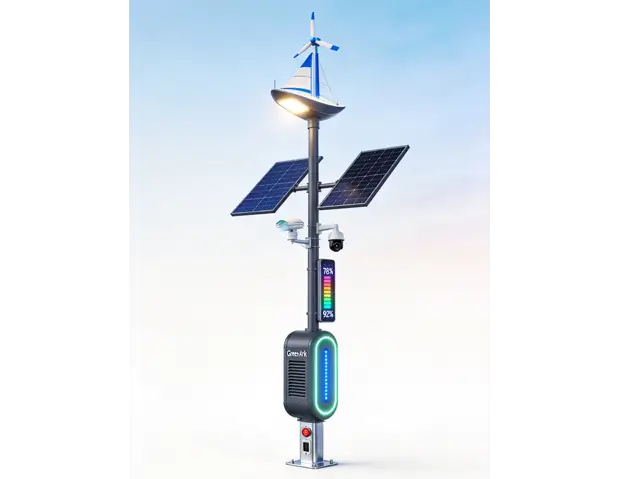
For example, a park renovation may use AP-ISLH-CL in small pathways, AP-ISLH-CV01 or CV02 on internal vehicle roads, and AP-MSCILH-PS near entrance roads where grid support is available and lighting continuity matters. If the same park also wants visible smart functions, the AP-SSL-WSH-ES-LOTUS product becomes a different kind of decision: it combines lotus-shaped 150W solar panels, an AilumPower HZP Series 25.6V/100Ah storage route, a 100W artistic spiral micro turbine, a 50W center warm white LED, color-changing ambient lighting, a compact P4 LED screen, a PTZ camera, and a drone docking pad. It should not be treated as a normal spacing substitute for AP-ISLH-CV.
AP-SSL-WSH-ES-GA is a wind-solar hybrid smart street light with a 200W bifacial monocrystalline PV route, AilumPower HZS-100-16S stacked 51.2V/100Ah storage, a 300W vertical-axis micro wind turbine, 80W warm white lighting, a P3 320 x 640mm LED screen, a 400W HD PTZ camera, environmental monitoring sensors, and 4G/5G plus RS485 communication. A buyer may still place these poles along a road, but the spacing question changes because the product is also a smart infrastructure node. Visibility of the screen, camera coverage, wind exposure, solar exposure, and maintenance access become part of the layout.
AP-ISLH-CV uses batwing light distribution of 150 degrees by 75 degrees across its 60W, 80W, and 120W options. That matters because spacing is not only about brightness directly below the pole. A buyer wants to avoid dark gaps, glare, and uneven pavement lighting. The actual spacing should be confirmed with project lighting calculations, but the purchase file can already prepare the correct product route, mounting pipe diameter, package dimensions, weight, and mounting height before the lighting designer finishes the final layout.
A useful request should include a site drawing, road width, pole location restrictions, expected mounting height, whether poles are one-side, opposite, staggered, or median-mounted, and whether the project needs solar-only, mains-solar hybrid, or wind-solar hybrid products. The buyer should also state whether the zone is a vehicle road, pedestrian path, scenic space, industrial road, or campus route. That information allows the product route to be discussed honestly.
For AP-ISLH-CV orders, the buyer should identify whether CV01, CV02, or CV03 is likely. The file should include rated power, system voltage, battery specification, panel specification, pipe diameter, weight, recommended mounting height, and package dimensions. For AP-MSCILH-PS, it should show the power group, battery group, controller route, panel group, 6-12h lighting time expectation, and 6-10m mounting height. For AP-SSL-WSH-ES-GA or LOTUS, it should show whether the pole is being selected for lighting only or for smart functions and public-space design.
A contractor replacing old lights should also send photos of existing poles, pole arm orientation, nearby trees, and road edges. Those details help separate a simple lamp-head replacement from a new spacing design. If the existing pole positions must stay, the buyer may need to choose a product route that works within fixed mounting locations. If new pole foundations are allowed, the designer has more room to optimize spacing around the AP-ISLH-CV, AP-MSCILH-PS, or smart hybrid pole route.
A distributor preparing a tender response should avoid promising a universal spacing number in the first quotation. A better response is to show the likely AilumPower product family and the missing site data required for final spacing. That makes the quote more professional and reduces the risk that a later drawing forces a different product route after pricing has already been approved.
After the order is placed, the spacing decision should remain visible during receiving. The warehouse should not receive AP-ISLH-CV, AP-MSCILH-PS, AP-SSL-WSH-ES-GA, or AP-SSL-WSH-ES-LOTUS as anonymous lighting goods. Carton labels should be matched to the road zone, pole height, and drawing reference. If AP-ISLH-CV03 belongs to a 10m or 12m route, it should not be mixed with AP-ISLH-CV01 units intended for lower mounting. If AP-MSCILH-PS is used only near entrance roads, its power group, controller, panel route, and hybrid operating note should stay with that section of the delivery record.
This receiving step is not paperwork for its own sake. Solar street light spacing is only useful if the correct product reaches the correct pole position. A site may have good lighting calculations and still fail during installation if cartons are opened out of order, if the drawing does not name the product route, or if the installer cannot tell which poles need the hybrid lamp head. A clear receiving record protects the original design decision.
A buyer should not lock final solar street light pole spacing when the road width is unknown, when the pole height is still changing, when trees or driveways will interrupt the line, when the project mixes path lighting and road lighting, or when smart pole functions affect where poles must stand. The better purchase route is to approve the product family and the likely model group first, then let the lighting layout confirm the final pole count.
For a straightforward campus branch road, that may mean selecting AP-ISLH-CV01 or CV02 and asking the lighting designer to confirm spacing against the actual drawing. For an entrance road with grid access, AP-MSCILH-PS may be reviewed because the mains-solar hybrid route protects the operating plan. For scenic public spaces, AP-SSL-WSH-ES-LOTUS may be selected for its integrated solar, wind, storage, display, camera, and landscape design role. The buyer gets a cleaner order when each zone has its own spacing logic instead of forcing every pole into one rule.
