

Get quote
Get Free Consultation!
We are ready to answer right now! free consultation.
Email:ttxxkj888@gmail.com
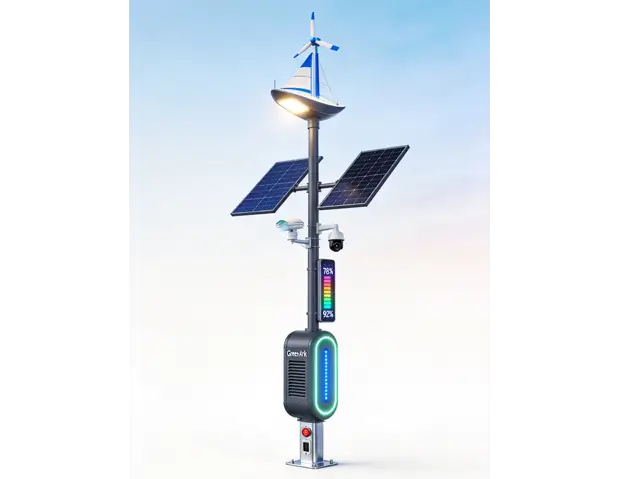
A smart street light with camera and LED screen is suitable for buyers who need more than night lighting. It fits campus entrances, municipal demonstration roads, industrial parks, public plazas, scenic routes, and clean-energy streets where lighting, power generation, surveillance, information display, and communication may be installed on the same pole. For AilumPower, the first products to compare are AP-SSL-WSH-ES-GA and AP-SSL-WSH-ES-LOTUS, because both include lighting, renewable generation, energy storage, camera, screen, and communication or control functions.
The first specification question is whether the project really needs the camera and display at every pole. If the answer is no, the buyer may need a mixed plan with smart hybrid poles in key zones and simpler integrated lamp heads in ordinary lighting zones.
A smart pole order becomes expensive and hard to maintain when every road section is treated the same way. A campus entrance may justify a camera and LED screen because it has visitors, traffic, and public messaging needs. A quiet service lane may only need reliable lighting. A scenic plaza may need a decorative light form, ambient lighting, and a display that supports public information. The product route should follow these zones instead of a single model repeated across the entire project.
AP-SSL-WSH-ES-GA is built for a smart street light route with clean-energy visibility. It includes bifacial monocrystalline 200W solar PV using 2 x 100W symmetric tilt panels, AilumPower HZS-100-16S stacked 51.2V/100Ah storage with 5.12kWh energy, a 300W vertical-axis micro wind turbine, an 80W warm white 3000K sailboat-shaped LED head, a P3 320 x 640mm vertical LED screen, a 400W HD PTZ camera, and 4G/5G plus RS485 communication.
A municipal or campus entrance may need lighting, a screen, camera coverage, communication, and a visible renewable-energy structure. AP-SSL-WSH-ES-GA belongs in this kind of high-function zone.
A park or cultural path may value the form of the pole as much as the camera or display. AP-SSL-WSH-ES-LOTUS should be reviewed when the lighting product also needs to act as a landscape feature.
The GA model should be described as a system in the purchase file. The solar PV, wind turbine, storage, LED lighting, screen, camera, sensors, and communication all create separate specification and maintenance questions. A buyer should not approve the product only from a rendering or pole photo. The order should list the PV route, storage route, turbine power, LED head, screen size, camera function, and communication plan.
For a road contractor, this means the installation file should include pole foundation requirements, cable routing, display orientation, camera viewing direction, and service access. For a distributor, it means the product cannot be stocked like a normal lamp head. The accessory package, screen parts, camera, communication items, and renewable-energy components need careful receiving and packing records.
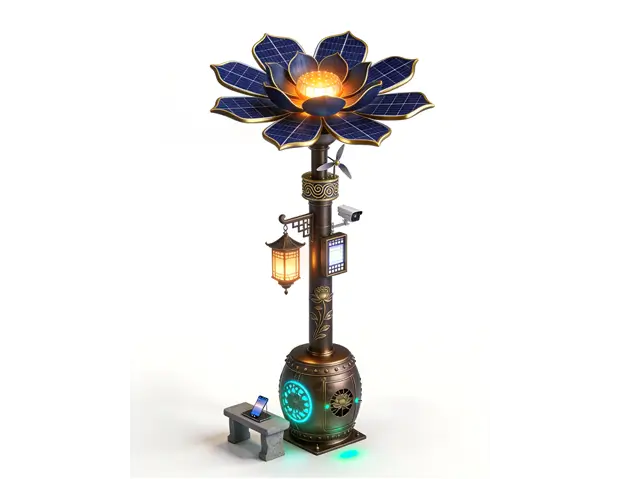
AP-SSL-WSH-ES-LOTUS uses lotus-shaped multi-petal 150W solar panels, AilumPower HZP Series 25.6V/100Ah storage with 2.56kWh energy, a 100W artistic spiral micro wind turbine, 50W center warm white LED lighting, color-changing petal ambient lighting, a compact P4 LED screen, a PTZ camera, and landscape-mode dispatch with holiday light show control. These details make it a different answer from GA.
A buyer should consider LOTUS for plazas, scenic roads, cultural parks, and public-facing areas where the pole is part of the environment. It may not be the best route for ordinary service roads where appearance and ambient lighting do not matter. In those areas, AP-MSCILH-PS, AP-ISLH-CV, or AP-ISLH-CL may be a more practical lighting choice.
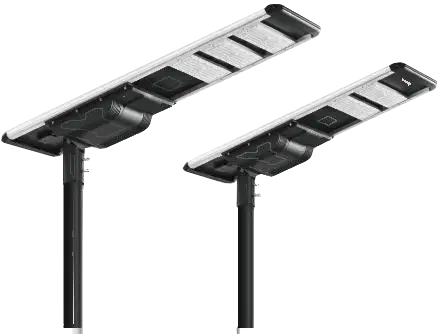
Many projects that ask for a smart street light with camera and LED screen still have zones that need only lighting. AP-ISLH-CV offers 60W, 80W, and 120W integrated solar lamp head routes, with DC12V for CV01 and DC24V for CV02 and CV03. AP-ISLH-CL offers 10W and 15W routes for smaller paths, park edges, and lower-power areas. These products can reduce cost and maintenance load in places where a screen or camera is not useful.
AP-MSCILH-PS should be considered when a road needs a mains-solar hybrid lamp head rather than a full smart pole. It offers 60-70W through 140-150W power routes, SRNE MPPT controller options, 18V monocrystalline panel routes, 6-12h adjustable lighting time, IP65 protection, and 6-10m mounting height. That is a different specification path from GA or LOTUS, but it may fit normal road lighting better.
For GA or LOTUS, receiving inspection should not stop at the pole body. The buyer should check solar panel parts, turbine parts, lighting head, screen, camera, storage unit, communication items, sensors, mounting hardware, and visible finish condition. Each item should be connected to the approved model. If the project mixes GA and LOTUS, they should be separated in the delivery schedule, because their storage, turbine, lighting, and visual parts are not the same.
The packing note should also identify which products belong to which road or public-space zone. A smart pole installed in a campus gate, a decorative hybrid light in a plaza, and a simple integrated lamp head on a pathway may arrive in the same logistics plan. Without zone labels, the receiving team can create confusion before installation even begins.
A screen and camera should have a job. A buyer can use a smart pole at an entrance to show site information, support monitoring, or create a visible clean-energy landmark. The same screen may be unnecessary on a quiet internal path where few people pass. Before the order is approved, the project team should mark the exact pole locations that need a screen, camera, sensor, communication, and extra renewable-energy components. That location map should then drive the model selection.
For AP-SSL-WSH-ES-GA, the project team should consider screen orientation, camera viewing direction, turbine clearance, PV exposure, pole foundation, and service access. For AP-SSL-WSH-ES-LOTUS, the team should also think about visual spacing, landscape fit, ambient lighting use, and whether holiday light-show control is part of the public-space plan. These details cannot be solved by the product title alone. They belong in the specification file before the shipment is packed.
A smart lighting project may include GA poles, LOTUS poles, AP-MSCILH-PS lamp heads, and AP-ISLH-CV lamp heads in the same phase. The purchase file should separate them by zone and function. Smart poles with cameras and screens should be packed and received as multi-function systems. Lamp heads should be packed and received as lighting products. If the buyer mixes these in one line item, the warehouse and installer may not know which accessory package belongs to which pole.
The delivery schedule should include product names, site zones, quantities, image references, and the main function of each product group. For example, GA may be assigned to main entrances, LOTUS to landscape plazas, AP-MSCILH-PS to grid-supported roads, and AP-ISLH-CV to ordinary solar road lighting. This makes the order easier to audit before delivery and easier to repeat when a later project phase needs the same product mix.
The maintenance plan for a smart street light with camera and LED screen should list each function separately. For GA, the service record should separate the 200W solar PV route, 300W vertical-axis micro wind turbine, 5.12kWh stacked energy storage, 80W LED head, screen, camera, communication, and sensor functions. For LOTUS, the record should separate the 150W petal solar panels, 100W artistic spiral turbine, 2.56kWh storage, center LED light, ambient petal lighting, screen, camera, and control functions.
This separation matters because a later service problem may not be a lighting problem. It may be a screen orientation issue, a camera viewing issue, a communication issue, a storage issue, or a turbine issue. A buyer who writes only “smart street light maintenance” in the file may leave the service team without enough detail. A clear component list makes spare parts, inspection photos, and replacement decisions easier to manage.
Some buyers ask for smart poles because they want a modern project image, but the actual site may not need a camera, screen, turbine, or communication route. If the pole is in a quiet service area, a simpler integrated lamp head may give better value. AP-ISLH-CV can serve stronger road lighting needs, while AP-ISLH-CL can serve lower-power pathway needs. AP-MSCILH-PS can serve grid-supported lighting without turning the pole into a full smart system.
The buyer should reduce the specification when the extra smart functions have no owner, no maintenance plan, or no clear use. A screen that no team updates becomes dead equipment. A camera without a monitoring plan becomes an unused cost. A turbine or storage route without service records becomes harder to troubleshoot. Smart poles should be placed where their functions are planned, used, and maintained.
Many smart lighting projects are built in phases. The first phase may use a few GA poles at the main entrance and simpler lamp heads elsewhere. A later phase may add LOTUS poles in a plaza or more AP-MSCILH-PS lamp heads on a grid-supported road. The buyer should keep a phase record with product names, site zones, images, and function notes so the second phase can repeat the right product without copying the wrong pole into a different zone.
This phase record should also include the reason each product was chosen. GA may be chosen for renewable generation, display, monitoring, and communication. LOTUS may be chosen for landscape appearance and ambient lighting. AP-ISLH-CV may be chosen because the road only needs lighting. Those reasons make future procurement cleaner than a simple quantity list.
If the project later expands, the buyer can compare the new zone against that record instead of starting from a blank specification. That saves time and keeps the smart functions tied to real locations.
The same record also helps the warehouse separate screens, cameras, lamp heads, pole accessories, and renewable-power parts before they move to the installation team. That separation protects both installation speed and later service accuracy.
For GA deliveries, the installation note should keep the P3 320 x 640mm screen and 400W HD PTZ camera matched with the correct pole set. For LOTUS deliveries, the note should keep the P4 screen and artistic turbine parts with the scenic lighting group.
Use GA when a road or entrance needs a strong smart pole route with PV, wind, storage, lighting, screen, camera, and communication. Use LOTUS where the product must also support landscape value and public-facing appearance. Use AP-MSCILH-PS, AP-ISLH-CV, or AP-ISLH-CL in zones where lighting is the main task and camera or screen functions would add maintenance without a clear use. The best smart lighting plan is usually mixed by zone, not repeated blindly from one pole to every corner of the project.
